



Ref : NISMHM
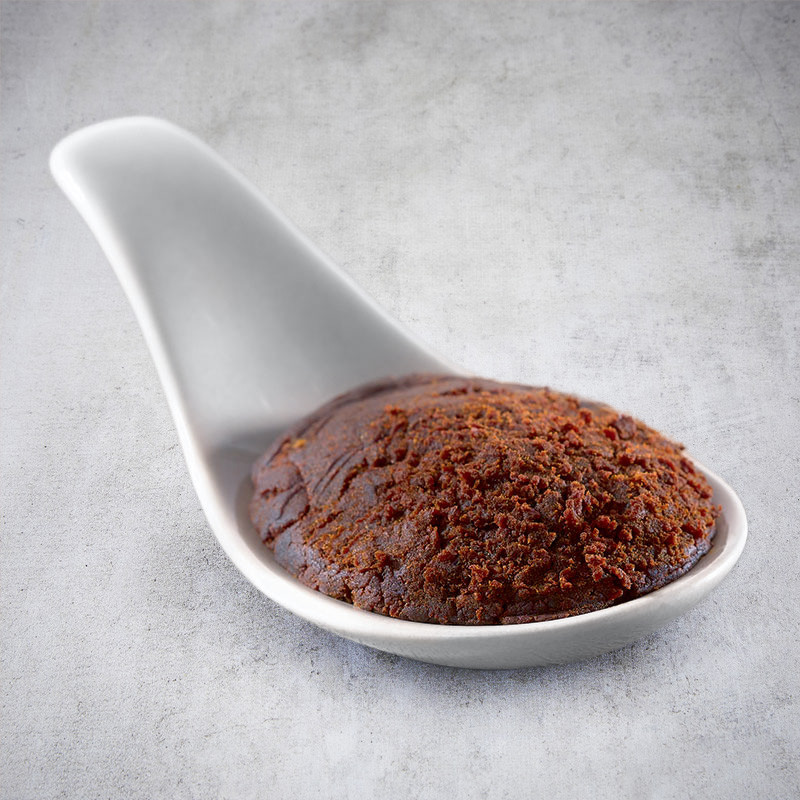
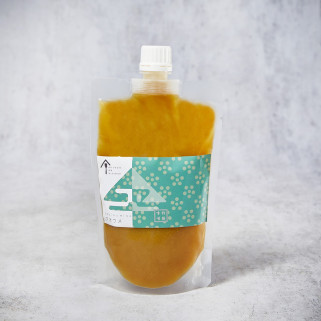
This is the dehydrated Hatcho miso paste.
More about japanese miso paste 
The nose is intense, with cocoa, malted, coffee, chicory notes, very powerful.
Our perfect combination : it offers possibilities of use in pastry and chocolate, catering preparations, aromatization of salts ...
This Hatcho powder is a real condiment and perfectly notes red meat, mixed salads, eggs, rice, pasta, mini puff pastry, soups, scallops, carpaccios of meat and fish ...
Data sheet
 MARUYA HATCHO MISO
Where does the name "Hatcho Miso" come from?
"Cho" is an old unit of length, corresponding to 109.09 meters. Hat (diminutive of hatchi) means "8" and Hatcho can therefore be translated as 8-cho or 870 meters. Maruya Hatcho Miso House, located in Hatcho Commune, Aichi Prefecture, is located at a distance of Hatcho (870m) from Okazaki Castle. This area was a strategic point for shipping because it was the crossroads of the ancient Tôkaido road, a point taken by boats on the Yahagigawa River. During the Edo period (1603-1868), it was a port that enjoyed the monopoly of salt trading. It was therefore easy to obtain ingredients such as soya and salt for the production of miso, which was then delivered by sea transport.
Maruya Hatcho miso develops its products according to ancestral processes of natural fermentation in large barrel of cedar wood (barrel of 2 meters in diameter).
The manufacture of the Hatcho Miso responds to very specific steps :
very careful selection of the best soya beans, washing and rinsing the beans then soaking in clear water, draining then steaming, natural cooling, making balls the size of tennis balls with the paste obtained and then sowing in natural yeast, realization of Kôji (must of priming obtained after saccharification of the starch of soya beans) that will be allowed to rise.
The Kôji, in the form of balls is then crushed and mixed with salt and water to obtain the "moromi" or must. The mixture is placed in cedar barrels in stages. The master craftsmen then enter the barrel and trample the mixture to flatten and homogenize. This operation is repeated layer by layer.
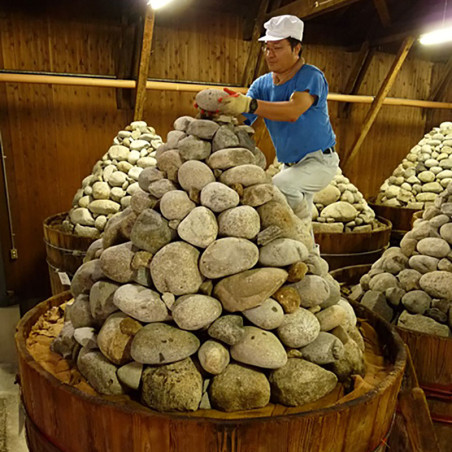
The last layer is covered with a cloth of linen and then will be placed the stones so as to compact and compress the mixture so that it can ferment naturally.
 Constance S.

Incredible (Translated review)
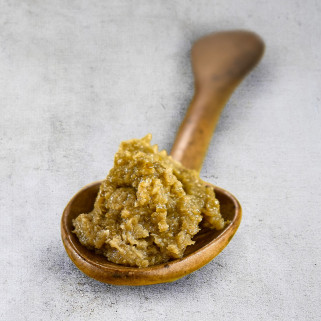
This is the dehydrated Hatcho miso paste.
More about japanese miso paste

ALCOHOL ABUSE IS DANGEROUS FOR YOUR HEALTH. CONSUME IN MODERATION. CONSUMING ALCOHOLIC BEVERAGES DURING PREGNANCY, EVEN IN SMALL QUANTITIES, CAN HAVE SERIOUS CONSEQUENCES FOR THE HEALTH OF THE CHILD.


FAQ