

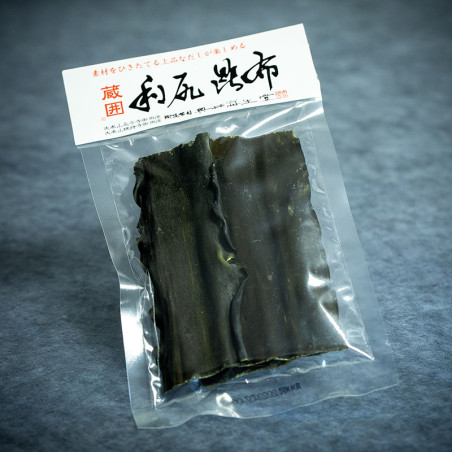

Ref : NISOKAI7
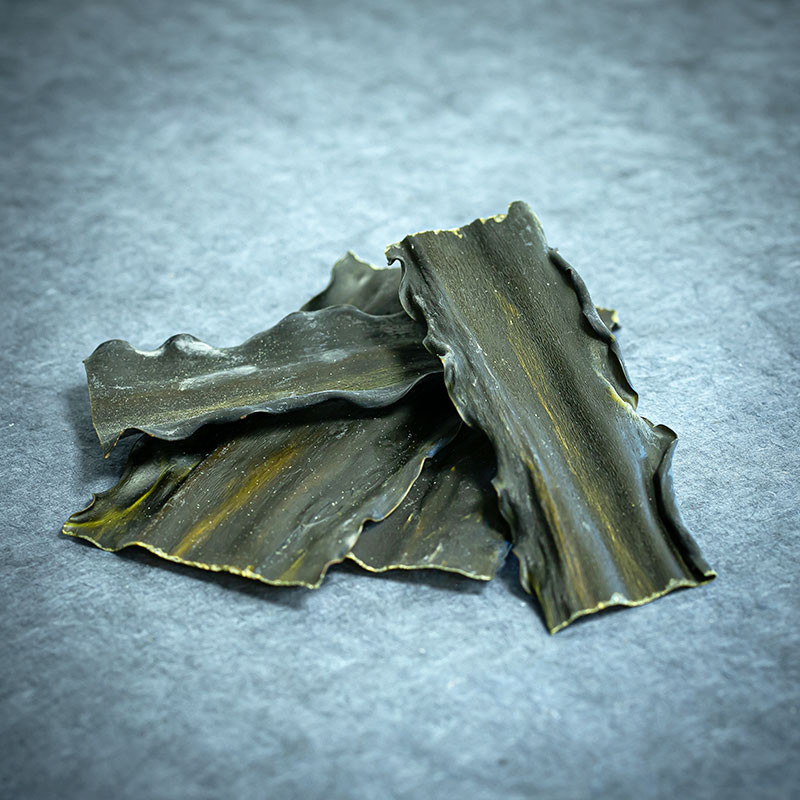
Kombu proposed here comes from Rishiri and Rebun islands, located north of Hokkaido Island, renowned for their wild kombu, the rarest and most qualitative in the world.
Only a few privileged people have access to them and Okui Kaiseido, our artisan, is recognized in Japan as the absolute reference.
All Kombu from Okui Kaiseido are preserved and aged in a special ageing cellar, at controlled temperature and humidity, using the Kura-gakoi technique, as for the preservation of wine.
This method reduces smell of the sea and unpleasant taste of Kombu flesh and brings out true UMAMI, offering subtlety and elegance to tasting.
Cellar and storage boxes are made of Japanese cedar wood. Kura-gakoi process enhances kombu, developing its flavors and concentrating umami, resulting in an exceptional dashi.
Our recommendation for making your own dashi :
Soak kombu for 24 hours in cold water to soften it.
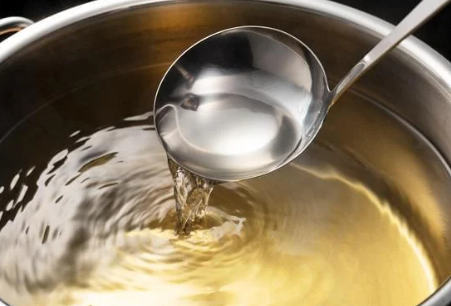
First dashi, called Ichiban dashi, is an almost pure umami broth. Synergy between kombu and katsuobushi produces and enhances clear umami taste.
Made from the finest ingredients, it has a rich golden color and no astringency as is usually the case with dashi made from other ingredients.
Clear, subtle aroma of ichiban dashi is ideal for making clear broths. Ichiban dashi itself is delicious, but it allows you to bring out flavor of other foods without paying too much attention to other ingredients.
 For a good dashi :
♦ 1800 ml of fresh water
♦ 30-40g of Rishiri kombu
♦ 50g of katsuobushi (blood line should be removed)
1. Put the water and kombu in a large pot and heat over low heat
2. Slowly increase temperature to 60°C and simmer for 1 hour at this temperature to bring out maximum umami of the kombu.
3. Remove kombu and increase temperature to 85°C over high heat. When temperature reaches 85°C, add katsuobushi flakes so that they soak up water completely.
4. After waiting about 10 seconds, strain liquid through a fine-mesh cloth and let it drain naturally without squeezing katsuobushi flakes.
 Kombu contains glutamic acid, a type of amino acid with UMAMI. Glutamic acid umami can be enhanced by aging Kombu and it also increases synergistically when combined with inosine acid included in dried bonito. Kombu is also rich in dietary fiber, calcium and iodine. Its alkaline nature helps maintain a balance with acidic foods such as meat and fish.
Data sheet
 OKUI KAISEIDO
 Just like great wines, kombu quality depends on harvesting area, active sea currents in the growing area, relief and rivers near beaches and their alluvial deposits, exposure to the sun... Kombu sought by Okui must be harvested at perfect maturity, from July to September, after at least two years of growth. Seaweed then reaches a length of 2.5 to 3 meters and even 10 meters for the most exceptional specimens. Kombu seaweeds are dried exclusively in the sun until they have a nice dark bronze to black exterior color, while preserving a light interior color.
OKUI KAISEIDO kombu:
Rishiri & Rebun Kombu
Rishiri & Rebun kombu are the kings of kombu and the most expensive in Japan. They are known to have a tough fiber and it is usually difficult to extract the umami. Slowly heated to 60℃ they produce a very clean and rich dashi with a golden color. They are essential ingredients in Kaiseki and Shojin cuisines and are known for their mild flavor.
Rausu Kombu
Rausu kombu has a very soft fiber and is known for its broad and thin shape. When soaked in hot water, it gives a slimy, gooey texture and a rich umami flavor. Rausu creates a very richly flavored dashi, with a darker brown color than Rishiri or Makombu dashi. It is well used for Kobujime (raw fish refined by wrapping it in kombu) and Kobumaki (kombu rolls filled with cooked fish).
Hidaka Kombu
Hidaka kombu has soft fibers and is usually whole. This whole kombu is used for simmered dishes, Kobumaki (rolled kombu filled with cooked fish) and tsukudani condiments (kombu candied in a mixture of soy sauce, mirin, sake, sugar). It can create a darker brown, less sweet dashi with a strong kombu taste. It is not usually used to make traditional dashi.
Makombu
Makombu is a high quality kombu such as Rishiri or Rebun. Its fiber is softer than Rishiri. It is mainly used in the Osaka area, while Rishiri is popular in Kyoto. Makombu dashi has a rich golden color and a mild, sweet flavor. Its shape is wider and thicker than the others. It is used for cooking like shio-kombu and tsuo and tsukudani-kombu. It is also favored for making special forms of kombu by hand and presented at religious events as special offerings.
 Arnaud R.

Refined (Translated review)
Brigitte G.
discovery of "refined" Kombu seaweed with a more intense taste (Translated review)
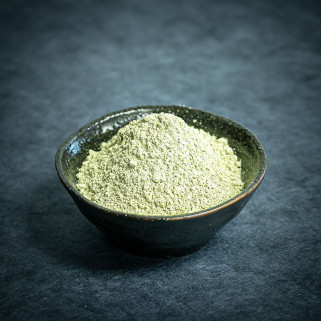
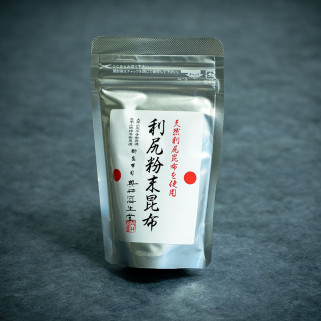
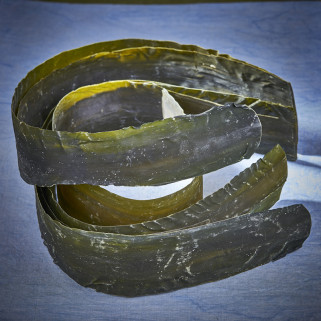
Kombu proposed here comes from Rishiri and Rebun islands, located north of Hokkaido Island, renowned for their wild kombu, the rarest and most qualitative in the world.
Only a few privileged people have access to them and Okui Kaiseido, our artisan, is recognized in Japan as the absolute reference.

ALCOHOL ABUSE IS DANGEROUS FOR YOUR HEALTH. CONSUME IN MODERATION. CONSUMING ALCOHOLIC BEVERAGES DURING PREGNANCY, EVEN IN SMALL QUANTITIES, CAN HAVE SERIOUS CONSEQUENCES FOR THE HEALTH OF THE CHILD.


FAQ